


Why baby wakes EVERY 2 HOURS. All night long.


Two hours seems to be the magic (and dreaded!) number of hours many babies will sleep before waking again. All. Night. Long.
You might have noticed (we certainly have) that this tends to happen more beyond the 4 month mark, but it can certainly happen for younger babies too, especially from midnight onwards. If your baby is waking even more frequently than every 2 hours, closer to every hour, every single sleep cycle, we cover that pattern in detail later in this article.
In this article:
- Why your newborn is waking up every 2 hours
- The 4 month sleep regression
- Why your 4-6 month old is waking up every 2 hours
- How to encourage a longer stretch of sleep at night
Please note that we are not referring to newborn babies waking for feeds every couple of hours, which is quite normal and to be expected! Instead, we are referring to those babies who had maybe started sleeping longer stretches at night and then suddenly reverted to waking every 1-2 hours. Or babies who have been sleeping well between bedtime and midnight and then waking 2 hourly after that, or babies who have continued to wake every 1-2 hours well beyond the newborn stage.
We also have to say that the purpose of this article isn't to discourage you from responding to your baby overnight or to in any way "force" your baby to sleep through the night if they aren't ready. We simply want to share our knowledge of what can cause this overnight change in your baby's sleep cycles and some possible ways around it.
Because sleep changes so much as babies grow, the best solution will depend on your baby’s age and stage. Our smart sleep app removes all the guesswork and handles your baby's daily sleep rhythm automatically to effortlessly manage naps and reduce night wakes.
Let's start by looking at your newborn baby...
Your newborn baby's sleep and sleep cycles are still relatively immature at this age. They will more easily drift between sleep cycles in the day, meaning you can often achieve nice long naps.
By around 6 weeks, your baby will hopefully have started consolidating their sleep into more noticeable awake and nap periods in the day and might well have begun sleeping in longer stretches overnight too. Their night-time sleep periods at this age can be around 4-6 hours long, waking just once or twice for a feed. When this happens, you can feel like a new person again after coming through the tricky and exhausting newborn phase!
Suppose that hasn’t happened though, and your baby is still waking every 1-2 hours overnight. In that case, there are many possible reasons for this, including:
- hunger
- under or over tiredness
- their startle reflex waking them
- trapped wind
- reflux
- an issue in the sleep environment.
We’ll go through some of these factors in more detail towards the end of this article.
By around 12 weeks, some babies will have been sleeping like champs, sometimes even through the whole night! Until...
Somewhere around 3-4 months old...
Between 3-4 months, your baby's sleep neurology matures. This is commonly called the 4 month sleep regression as it can cause a pretty big regression in your baby's daytime napping and their night-time sleep too. It can be especially devastating if you'd gotten used to the longer sleep stretches at night!
What happens at this point is your baby's sleep has dramatically changed to become more organised into defined sleep cycles. The daytime cycles change first and your baby's level of arousal between their daytime cycles increases, meaning they can start to fully wake at the end of each sleep cycle, which is around 45 minutes long.
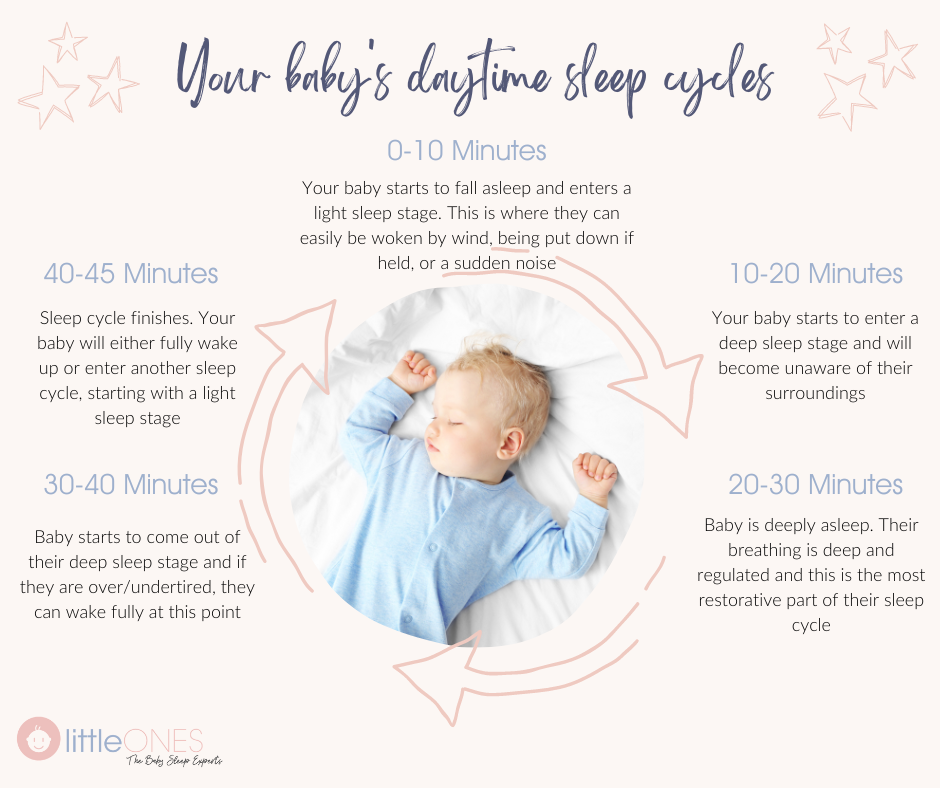
Sound familiar? Sleeping for one sleep cycle at a time, all day long is known as 'catnapping' and you can read more about how to manage this in our catnapping article.
At this point, although your baby may be catnapping in the day, they might still be doing good long chunks of sleep overnight. Many people are happy to tolerate the shorter day sleeps because the nights are still manageable. Until that changes too...
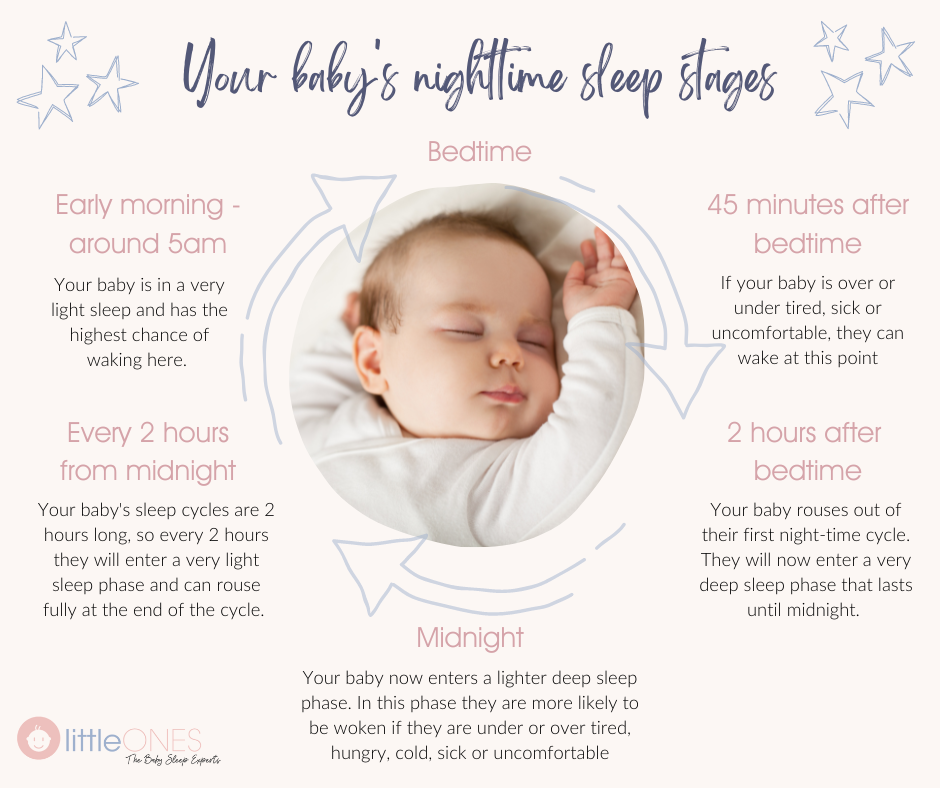
Around 4 months, your baby will likely start waking every 1-2 hours at night because their sleep cycles there have matured as well. Your baby's night sleep becomes more like an adult's, with sleep cycles that are approximately 60 to 90 minutes long.
Towards the end of each sleep cycle they will enter a very light sleep phase and easily wake, often needing help get back to sleep.
Your 4-6 month old's night sleep...
night-waking-and-sleep-cycles
Between 4 - 6 months, if your baby is already self-settling, you may experience them having a noisy resettle every couple of hours. This is where they will wake and cry briefly and then go back to sleep. If your baby is resettling back to sleep without your help, it's totally fine to leave them to it.
If your baby isn't self-settling yet though, or something else is bothering them, they will often wake up completely and need your help to go back to sleep. Every 1-2 hours.
What is self-settling?
Once your baby has reached this sleep milestone of their daytime and night-time cycles maturing, their sleep habits and sleep associations really come into play.
This means that if your baby has learnt to go to sleep by being actively settled, i.e. by you feeding or rocking them to sleep or by using a pacifier (that they cannot yet replace themselves), they will start to need that method replicated every time they wake between sleep cycles in the day (45 minutes) and at night (1-2 hours). This is because it is the only way they know how to go to sleep and go back to sleep!
Many babies this age can learn sleep cues and associations to help them fall asleep without the need to be actively settled. Things such as white noise, having a dark room, a consistent bedtime/nap routine and having age-appropriate awake times are all great ways to encourage your baby to self-settle to sleep.
Self-settling means that your baby can happily drift off to sleep independently when all the conditions for sleep are lined up. They will also be able to resettle themselves back to sleep when they naturally wake between sleep cycles in the day and overnight, meaning that they no longer need you to actively settle them back to sleep each time.
I want you to know that teaching self-settling isn’t about leaving your baby to cry or forcing independence before they’re ready. It’s simply about helping your little one learn to drift back to sleep unassisted when they naturally stir between cycles. Our approach is always responsive and respectful of each baby's temperament. In our custom smart sleep app, we walk you through age-appropriate settling methods without a one-size-fits-all rule - just effective tools and real-time support so you can find what feels right for your baby and for you.
But my baby is only waking every 2 hours after midnight?
Many babies will enter a deep sleep from bedtime until midnight, then begin to wake 2 hourly after that. Parents will often assume that this isn't a settling issue, seeing as their baby can "self-settle" in the earlier part of the night. But, unfortunately, that longer stretch of sleep is more to do with the huge physiological drive to sleep that occurs in the first part of the night, rather than self-settling.
Between bedtime and midnight, your baby is being pumped full of the sleep hormone melatonin, and their body is pushing them strongly towards sleep. They begin their night well, sleeping deeply until around midnight, when the melatonin starts to drop out of their system. It continues to diminish between midnight and 7 AM and its total disappearance in the morning (as well as a rise in cortisol) is the thing that cues us to wake up.
From the middle of the night onwards, your baby is far more prone to wake up fully after each sleep cycle, simply because they're in a lighter sleep stage. So if they cannot settle themselves back to sleep or if anything is bothering them such as hunger, being too hot or cold, sickness, too much light in their room, or they are over or under tired, they will be very unsettled each time they naturally rouse and will need you to help them back to sleep. Every 1-2 hours. All night long.
So what can you do to encourage some longer stretches of sleep overnight?
Under or Over Tiredness
The first (and easiest) thing you can do to improve your baby's 2 hour nightly wakes is to ensure they aren't waking due to too much or too little day sleep. These factors will result in an unsettled baby between sleep cycles. Balancing day sleep is tricky because it’s never just about “how many naps” - it’s about helping your baby feel calm and ready for night sleep without tipping into overtiredness or undertiredness. Our sleep app does the thinking for you, with age-appropriate patterns, adaptive schedules customised to your unique baby and easy ways to adjust when things shift, so that daytime sleep supports the circadian rhythm and peaceful nights.
Hunger
Hunger is an obvious cause of a baby's night waking; however, beyond 4 months, your baby shouldn’t need to be feeding every 2 hours overnight, especially if they are able to go longer than this between feeds in the day. If you find your baby is waking and just having a few sucks before falling back asleep, it is more likely that they are wanting to suck themselves back to sleep rather than needing the milk for nutrition purposes.
Sleep Environment
Another quick and easy fix can be to tweak your little one's sleep environment. We recommend having a very dark room with no nightlight (until your little one is over 2 years old), using continuous white noise all night long and keeping their nursery the ideal temperature for sleep - around 18 degrees Celsius / 65 degrees Fahrenheit.
We also recommend making sure babies under 5 months (who aren’t rolling yet) are still swaddled, as this suppresses their startle reflex and is proven to help them sleep better. For older babies (or babies who are already rolling), use a baby sleeping bag so they can't kick their blankets off and get cold. Our product recommendations page has excellent swaddles, sleeping bags and blackout blinds.
Self-Settling
Above all else, your best line of defence against the 2 hourly wake is to encourage your baby to self-settle at the start of naps and at bedtime. Once they are doing this consistently at the start of sleep, resettling during the night should naturally follow suit.
Self-settling can feel like such a big step, but it’s really just helping your baby drift back to sleep on their own when they wake between cycles. Our sleep app has a range of effective, responsive settling options so you can choose what feels right and sustainable for your family.
night-waking-ready-for-longer-stretches
---------------
Bibliography:
St James-Roberts I, Roberts M, Hovish K, Owen C. Video Evidence That Infants Can Resettle Themselves Back to Sleep After Waking in the Night, as well as Sleep for Long Periods, by 3 Months of Age. J Dev Behav Pediatr. 2015 Jun;36(5):324-9.
Coons S, Guilleminault C. Development of consolidated sleep and wakeful periods in relation to the day/night cycle in infancy. Dev Med Child Neurol. 1984 Apr;26(2):169-76. PubMed PMID: 6724155.
Coons S, Guilleminault C. Development of sleep-wake patterns and non-rapid eye movement sleep stages during the first six months of life in normal infants. Pediatrics. 1982 Jun;69(6):793-8. PubMed PMID: 7079046.
Dewar, G. (2008-2014). Baby sleep Patterns: A guide for the science-minded. Retrieved from Parenting Science:
de Weerth, C., R.H. Zijl, and J.K. Buitelaar. Development of cortisol circadian rhythm in infancy. Early Hum Dev. 73(1-2): p. 39-52. 2003.

